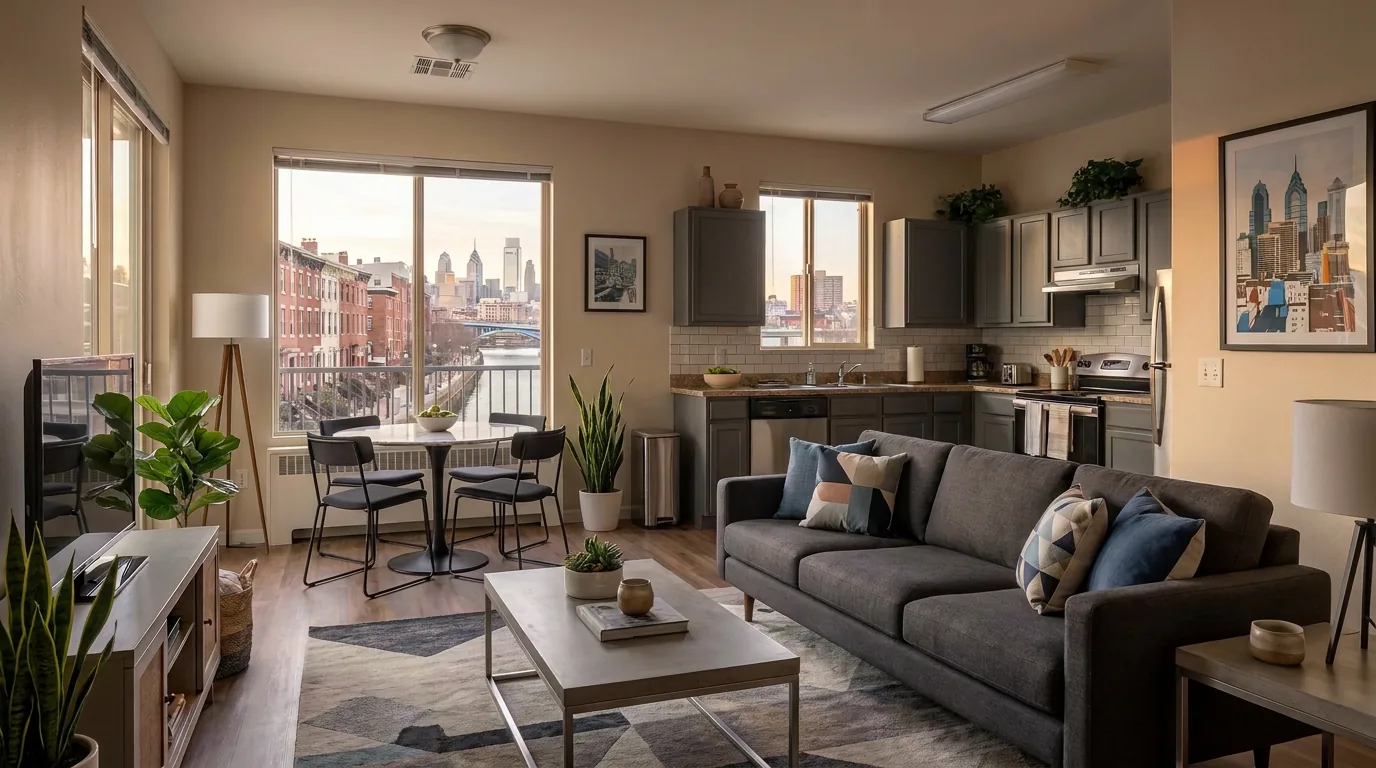
A furnished apartment living room with a city view
Home / Renters Insurance

Renters insurance, usually about $15 a month.

Your landlord insures the building, not your belongings and not your liability. This is the cheapest policy in insurance and the one most people skip.

HO-4
The Renters Policy Form
$15–25
A Month, Typically
Same Day
Proof For Your Lease
20+
Carriers Compared
The Quick Answer

Renters insurance is an HO-4 policy covering four things: your personal property, your personal liability, loss of use if the unit becomes unlivable, and small medical payments for a guest. Your landlord's policy covers the building and never your belongings or your liability. Pennsylvania does not require renters insurance by statute, but a landlord may require it as a lease term and many do. It commonly costs $15 to $25 a month here. Two details matter more than price: insure contents at replacement cost rather than actual cash value, and remember that each roommate needs their own policy. Kleppinger Insurance in Bethlehem shops it across more than twenty carriers at (484) 357-1485.

Policy form
HO-4 · four coverages
Typical PA cost
About $15 to $25 a month
Ask for
Replacement cost on contents
Free quotes
(484) 357-1485
Pennsylvania Renters Insurance, The Short Version

Your landlord insures the building. Not your things.

There is a persistent belief among tenants that the landlord's insurance covers them somehow. It does not, and it never has. A landlord policy covers the building and the owner's liability. If a fire starts two units down and destroys everything you own, the landlord's carrier rebuilds the structure and pays you nothing.

What fills that gap is an HO-4, and it costs roughly $15 to $25 a month in Pennsylvania. Add up what is actually in your apartment, the furniture, the laptop, the TV, the clothes, the bike, the kitchen. Most renters land somewhere between $25,000 and $40,000 without ever thinking about it, and would have to replace all of it out of pocket at once.

The liability half is the part nobody considers and the part that gets expensive. If a fire traces back to your kitchen and it spreads, you can be responsible for the damage to the building and to your neighbors' units. That is not a $2,000 problem. Renters liability is what stands between you and that bill, and it is the reason your landlord wants you to carry it.

Two decisions matter more than the premium. Insure your belongings at replacement cost, not actual cash value, so a four-year-old laptop is replaced rather than depreciated to almost nothing. And if you have roommates, each of you needs your own policy, because a policy covers the named insured, not whoever happens to live there.

If your lease requires coverage, we can quote it and email proof to your landlord the same day. Most of these take about ten minutes.

What renters insurance covers. And the four things it does not.

Four coverages come standard on an HO-4. The four in the middle are upgrades worth the few dollars they cost, and the last four are the gaps tenants are most surprised by.

Standard HO-4 coverage
Coverage C

Personal Property

Everything you own, against fire, theft, vandalism, windstorm and certain water damage. Add up the furniture, electronics, clothes, kitchen and bike and most renters are carrying $25,000 to $40,000 without realising it. Ask for replacement cost, not actual cash value.

Standard HO-4 coverage
Coverage D

Loss of Use

Pays for a hotel, a short-term rental, meals and the extra costs of living somewhere else while your unit is repaired after a covered loss. Commonly set around 20 to 40 percent of your property limit, and it is the coverage that keeps a fire from also becoming a housing crisis.

Standard HO-4 coverage
Coverage E

Personal Liability

Covers you if you injure someone or damage property, including damage that spreads from your unit to the rest of the building. Most policies start at $100,000; $300,000 usually costs very little more and is the better default in an older multi-unit building.

Standard HO-4 coverage
Coverage F

Medical Payments

A small no-fault limit that pays a guest’s medical bills regardless of blame. It exists to settle minor incidents before they turn into liability claims.

Worth adding
Ask for it

Replacement Cost on Contents

The single most important upgrade, and it is cheap. Actual cash value pays the depreciated worth of a four-year-old laptop, which is almost nothing. Replacement cost pays what it takes to buy a new one. Always confirm which one you are being quoted.

Worth adding
Add it

Scheduled Valuables

Policies carry low internal sublimits on jewelry, watches, firearms, cameras, musical instruments and bicycles, often around $1,500 total for theft. An engagement ring or a good bike needs to be scheduled individually, which also usually removes the deductible on those items.

Worth adding
Add it

Water Backup

Sewer, drain and sump backup is excluded from the base policy. In a garden-level or basement apartment in an older building, this is the single most likely claim you will ever have. Inexpensive to add.

Worth adding
Worth knowing

Off-Premises Coverage

Your property is covered when it is away from home, usually at a reduced percentage of your limit. A laptop stolen from your car is a renters claim, not an auto claim, because auto policies do not cover personal belongings. Luggage lost on a trip generally counts too.

Not covered
Never covered

The Building Itself

Structure, roof, walls, plumbing and the landlord’s appliances belong to the landlord policy. If a roof leak damages your things, your policy covers your things and the landlord’s covers the roof.

Not covered
Never covered

Your Roommate’s Belongings

A policy covers the people named on it. If the apartment is robbed, an unnamed roommate collects nothing. Roommates should each carry their own policy rather than assume one covers the household.

Not covered
Separate policy

Flood

Excluded from renters insurance exactly as it is from homeowners. Rising water from the Lehigh, the Monocacy or heavy surface runoff needs separate flood coverage, and ground-floor units near water are the ones to think about it.

Not covered
Not covered

Bed Bugs, Vermin & Wear

Infestations, mold from an ongoing leak, and ordinary wear and tear are maintenance issues rather than sudden accidental losses. Depending on the cause they may be the landlord’s responsibility, but they are not an insurance claim.

Need proof of insurance before you sign the lease?

We do this constantly and it is usually same-day. We will add your landlord as additional interest and send the certificate straight to them.

Coverage Basics

How much to buy, and the three settings that matter.

Replacement cost versus actual cash value

This is the setting that decides what a claim is worth, and it is buried in a line most people never read. Actual cash value pays what your things are worth today, after depreciation. A five-year-old television might settle for a couple of hundred dollars. Replacement cost pays what it costs to buy a comparable new one.

The premium difference is usually a few dollars a month. The claim difference can be thousands. If you take one thing from this page, make it this: confirm your policy says replacement cost on contents, and if it does not, ask us to fix it.

How much personal property coverage you need

Walk the apartment room by room and add it up honestly. Furniture, mattress, television, laptop, phone, kitchen equipment, clothes, coat, bike, tools, books, sports gear. Most renters arrive somewhere between $25,000 and $40,000 and are startled by the number, because nobody buys it all at once.

Then take pictures. A phone walkthrough of every room, closet and drawer, saved to the cloud, takes ten minutes and is the single most useful thing you can do before a claim. Adjusters pay for what you can document, and nobody remembers their own belongings accurately after a fire.

Sublimits: where policies quietly stop covering things

Your overall limit is not the limit for everything. Standard policies cap certain categories regardless of your total: jewelry and watches, firearms, silverware, cameras, musical instruments, business property and often bicycles. Theft sublimits on jewelry are commonly around $1,500 in total, not per item.

If you own an engagement ring, a good bike, a camera kit or an instrument, those get scheduled, listed individually with their own limit. Scheduling usually also removes the deductible on those items and broadens the covered causes to include simple loss, meaning a ring down the drain rather than only a burglary.

Liability, and why your landlord cares

Renters liability covers you when you are responsible for injury or damage, and in a multi-unit building the exposure runs beyond your own walls. A kitchen fire, an overflowing tub, a space heater against a curtain: damage that starts with you and spreads becomes your responsibility, and in an older Bethlehem or Easton building it can spread through several units.

That is exactly why leases increasingly require renters insurance. It is not the landlord being difficult, it is the landlord not wanting your accident to run through their policy and their loss history. $300,000 in liability rather than $100,000 usually costs a small amount more and is the sensible default.

Already have a policy? Let us read it with you.

Replacement cost or cash value, liability limit, loss of use, sub-limits on the ring. Four things, five minutes, no charge and no pitch.

Six ways to pay less for renters insurance. Without buying less of it.

The first one usually does most of the work: bundling with auto often saves more on the auto policy than the renters policy costs in the first place.

1

Bundle it with your auto policy

The discount on the auto side alone is frequently larger than the entire renters premium. It is genuinely common for renters insurance to end up close to free once the auto discount is applied, which is the single best argument for buying it through an agency that handles both.

2

Let us run the panel

Renters rates vary more between carriers than the small premium suggests, and the cheapest company for a downtown apartment is often not the cheapest for a student rental or a garden-level unit. It costs nothing to have us check all of them.

3

Pick the deductible you would actually use

$500 versus $1,000 changes the premium modestly. Since you should not be filing small renters claims anyway, the higher deductible is usually the better trade.

4

Mention the safety features

Monitored alarms, smoke and fire detection, deadbolts, sprinklers and secured buildings all carry credits. In a converted older building, sprinklers and central-station monitoring can move the rate noticeably.

5

Mind your credit

Pennsylvania permits credit-based insurance scoring on renters policies. It is not your credit score exactly, but it moves with the same inputs, and it is worth re-shopping after credit improves.

6

Do not underinsure to save three dollars

The temptation is to buy a $15,000 property limit because it is cheaper. The gap between $15,000 and $40,000 of coverage is small in premium and enormous in a total loss. Buy the coverage you would actually need and take the savings from the deductible instead.

Whatever you are renting. We cover it.

Students, roommates, first apartments and people between houses. The policy is small, but the details that make it work are specific.

About $12 a month to protect everything you own.

One call, a few questions about your place and your stuff, and you are covered. We can have the certificate to your landlord before you hang up.

Renters insurance across the Lehigh Valley. And all of Pennsylvania and New Jersey.

Bethlehem, Allentown and Easton have a deep rental market and a large student population living off campus. Most renters policies here take about ten minutes and we can send proof of coverage to a landlord the same day.

Pennsylvania renters insurance questions. Straight answers.

Is renters insurance required in Pennsylvania?

Not by state law. No Pennsylvania statute requires a tenant to carry it. But a landlord can require it as a lease condition, and that is legal and increasingly standard here, particularly in Allentown, Bethlehem and Easton and in student rentals.

If your lease requires it, we can quote the policy and email proof to your landlord the same day.

Doesn't my landlord's insurance cover my belongings?

No, and this is the most common misunderstanding in renting. Your landlord's policy covers the building and the owner's liability. If a fire that started elsewhere destroys everything you own, the landlord's carrier rebuilds the structure and pays you nothing.

Your belongings and your liability are yours to insure, which is what an HO-4 does for roughly $15 to $25 a month.

How much does renters insurance cost in Pennsylvania?

Commonly $15 to $25 a month, depending on your coverage limits, deductible, building and location. Higher-claim areas price a little above that and rural addresses a little below.

The bigger point: bundling it with an auto policy often saves more on the auto side than the renters policy costs in the first place. For a lot of clients it ends up close to free.

How much personal property coverage do I need?

Walk your apartment room by room and add it up honestly: furniture, mattress, TV, laptop, phone, kitchen, clothes, coat, bike, tools, books. Most renters land between $25,000 and $40,000 and are surprised, because nobody buys it all at once.

Then photograph everything, including closets and drawers, and save it to the cloud. Adjusters pay for what you can document, and nobody recalls their own belongings accurately after a fire.

What is the difference between replacement cost and actual cash value?

Actual cash value pays what your things are worth today after depreciation, so a five-year-old TV might settle for a couple hundred dollars. Replacement cost pays what it costs to buy a comparable new one.

The premium difference is usually a few dollars a month and the claim difference can be thousands. Confirm your policy says replacement cost on contents; if it does not, that is the first thing to change.

Do my roommates and I need separate policies?

Yes, in almost every case. A policy covers the people named on it. If the apartment is burgled and your roommate is not named, they collect nothing, and their liability is not covered either.

Some carriers will add a roommate, but it complicates claims and limits, and separate policies are inexpensive enough that splitting one rarely makes sense.

Does my student need renters insurance at college?

It depends on where they live. A student in a dorm is often covered under a parent's homeowners policy at a reduced sublimit. Once they move off campus into a house or apartment, that coverage typically stops applying and they need their own HO-4.

With Lehigh, Moravian, Lafayette, Muhlenberg, Cedar Crest and DeSales all nearby, this comes up constantly, and the policies are small and quick to write.

Is my laptop covered if it is stolen from my car?

Yes, under your renters policy, not your auto policy. Auto insurance covers the vehicle, not the personal property inside it. Renters insurance follows your belongings off the premises, usually at a percentage of your total limit.

The same applies to luggage lost while travelling and property stolen from a storage unit, generally subject to a lower limit.

Is water damage covered?

It depends on where the water came from, the same as with homeowners. A burst pipe or an overflowing appliance is generally covered. Sewer, drain and sump backup is excluded without an endorsement, and rising water from outside is flood, excluded entirely and requiring a separate policy.

If you are in a garden-level or basement apartment, the backup endorsement is the one to add. It is inexpensive and it is the claim you are most likely to have.

How fast can I get proof of coverage for my landlord?

Usually the same day, and often within about ten minutes of the call. Renters policies are quick to write, and we can email a certificate directly to your landlord or property manager.

If you are signing a lease this week, call and tell us the deadline. We will work to it.

Still have questions? Call (484) 357-1485. We will give you a straight answer.

Ten minutes, and it is done.
Proof to your landlord the same day.

Tell us the address and roughly what you own. We will run it across more than twenty carriers, set it up at replacement cost, and email the certificate wherever it needs to go.