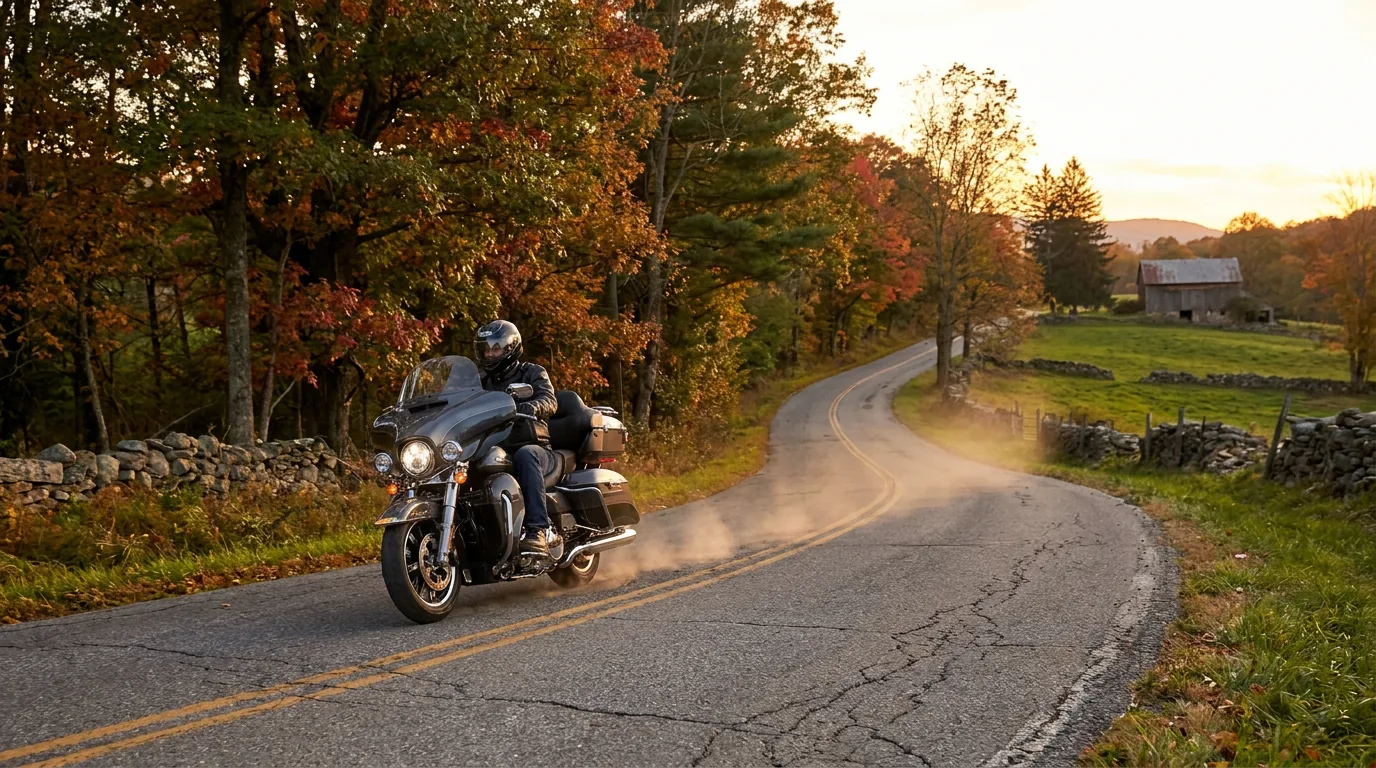
A touring motorcycle on a winding autumn road
Home / Motorcycle Insurance

Pennsylvania motorcycle insurance, built for riders.

Pennsylvania treats motorcycles differently from cars, and one of those differences leaves riders with no coverage for their own medical bills unless they add it.

15/30/5
PA Minimum Liability
Full Tort
Automatic for Riders
No PIP
Add MedPay Instead
20+
Carriers Compared
The Quick Answer

Pennsylvania requires 15/30/5 liability on a motorcycle, the same minimum as a car. Two things work differently for riders. Motorcyclists are excluded from Pennsylvania's no-fault system, so a rider holds full tort rights automatically even if their car policy carries limited tort. The trade-off is that riders are not eligible for first-party medical benefits, which means a motorcycle policy has no built-in coverage to pay your medical bills after a crash. The fix is Medical Payments coverage, plus strong uninsured and underinsured motorist limits. Pennsylvania has a partial helmet law and requires eye protection for everyone, and lane splitting and filtering are illegal here. Kleppinger Insurance in Bethlehem shops it across more than twenty carriers at (484) 357-1485.

Tort status
Full tort, automatic for riders
Medical benefits
Not included · add MedPay
Lane splitting
Illegal in Pennsylvania
Free quotes
(484) 357-1485
Pennsylvania Motorcycle Insurance, The Short Version

Riders sit outside the no-fault system. That cuts both ways.

Pennsylvania treats motorcycles differently from cars, and most riders find out how differently only after a crash. Two provisions drive everything on this page.

The first is good news. Because motorcycles are excluded from Pennsylvania's choice no-fault framework, a rider is not bound by the limited tort election. Even if you carry limited tort on the family car to save money, you retain full tort rights on the bike, meaning an unrestricted claim for pain and suffering against a driver who hurts you. You do not have to buy it and you cannot accidentally give it away.

The second is the expensive half. Riders are not eligible for first-party medical benefits, the coverage that pays a car occupant's medical bills regardless of fault. A motorcycle policy has no equivalent built in. So when a driver turns left across your lane and you are in an ambulance, there is no policy paying those bills as they arrive. You are relying on your health insurance, or on a liability settlement from the at-fault driver that may take months or years and arrives as one lump sum at the end.

That is why Medical Payments coverage is the most important optional coverage on a Pennsylvania motorcycle policy. It is inexpensive, it pays regardless of fault, and it fills exactly the hole the statute leaves. Paired with real uninsured and underinsured motorist limits, it is the difference between a manageable year and a financial catastrophe.

The rest is the part riders already care about: custom parts and equipment beyond the small factory allowance, safety apparel, guest passenger liability, and lay-up options for the months the bike is in the garage. We shop all of it across more than twenty carriers, because motorcycle appetite and custom-parts limits vary more between companies than almost any other line.
What Pennsylvania Law Actually Says

Four rules riders get told wrong.

Lane splitting is illegal here

California legalized it and the internet has been confusing riders ever since. In Pennsylvania, lane splitting and lane filtering are illegal. Riding between lanes of stopped or slow-moving traffic is not permitted, whether on Route 22 at rush hour or anywhere else in the Commonwealth.

This matters beyond the citation. If you are struck while doing something the law prohibits, the other side will use it, and Pennsylvania's comparative negligence rules mean a share of fault assigned to you reduces what you recover.

The helmet law is partial, not universal

Under 75 Pa.C.S. § 3525, riders under 21 must always wear a helmet. A rider 21 or older is exempt if they have either held a motorcycle license for at least two years or completed a PennDOT or Motorcycle Safety Foundation approved safety course. A passenger 21 or over may ride without a helmet only if the operator is also exempt.

Eye protection is required for everyone, with no age or experience exemption. That one gets forgotten constantly.

There is an insurance consequence to riding unhelmeted even when it is legal. Insurers routinely argue that a head injury would have been less severe with a helmet, and under Pennsylvania's modified comparative negligence rules that argument can reduce a recovery if a jury accepts it. It does not bar a claim outright while your share of fault stays at or below the statutory threshold, but it is a common tactic to shrink a settlement.

You already have full tort. Do not pay for it twice

Because motorcycles sit outside the no-fault system, riders hold full tort rights automatically. If an agent is selling you a "full tort upgrade" on a motorcycle policy, ask what exactly you are buying. Your tort status on the bike is set by statute, not by an election on the policy.

Your bike is not covered by your auto policy

A motorcycle needs its own policy. An auto policy does not extend to a motorcycle, and the coverages that matter most to a rider, custom parts, safety apparel, guest passenger liability, do not exist on a car form. Most carriers will still apply a multi-policy discount for keeping both with them, which is worth asking about.

What a Pennsylvania motorcycle policy needs. And the two things it will never cover.

Two coverages are required by law and neither of them pays for you. The ones that matter most to a rider are all optional, starting with MedPay.

Required by law
Required

Bodily Injury Liability

$15,000 per person and $30,000 per accident is the Pennsylvania minimum, the same as a car. It pays for people you injure, not for you. On a bike these limits run out fast, and we rarely recommend stopping at the minimum for anyone with assets or wages to protect.

Required by law
Required

Property Damage Liability

$5,000 minimum for the property you damage. That is roughly a bumper and a sensor on a modern vehicle, and it is your personal debt above the limit.

Strongly recommended
The critical one

Medical Payments (MedPay)

Because Pennsylvania riders get no first-party medical benefits, this is the only coverage on your own policy that pays your medical bills regardless of fault. It is inexpensive, it pays as bills arrive rather than at settlement, and it is the single most important optional coverage a Pennsylvania rider can buy.

Strongly recommended
Essential

Uninsured & Underinsured Motorist

Roughly seven to nine percent of Pennsylvania drivers carry nothing, and plenty more carry exactly 15/30/5. Because motorcycle injuries are frequently catastrophic and medical bills routinely run into six figures, UM/UIM matters more for riders than for anyone else on the road. Size it to your own liability limits.

Strongly recommended
For the bike

Collision

Repairs or replaces your motorcycle after a crash regardless of fault, including a low-speed drop in a parking lot. Required by any lender on a financed bike.

Strongly recommended
For the bike

Comprehensive

Theft, vandalism, fire, hail, falling limbs and animal strikes. Motorcycles are stolen at a far higher rate than cars, and comprehensive is what responds. Also covers the bike while it sits in storage over the winter.

Strongly recommended
Read the limit

Custom Parts & Equipment

Most policies include only a small allowance for aftermarket work, often $3,000 or less, and many riders have far more than that in exhaust, bags, seat, bars, paint, chrome and audio. Anything past the built-in allowance has to be declared and scheduled, with receipts. This is the most common underinsurance we find on motorcycle policies.

Strongly recommended
Add it

Safety Apparel & Riding Gear

Helmet, jacket, boots, gloves and armor are personal property, not part of the bike, and a full kit easily runs past $2,000. Many carriers offer a specific apparel endorsement that covers gear damaged in a crash, sometimes without a deductible.

Strongly recommended
Add it

Guest Passenger Liability

Not every motorcycle policy automatically covers a passenger to the same extent it covers you. If you ever ride two up, confirm this is on the policy rather than assuming it.

Strongly recommended
Seasonal

Lay-Up & Storage Options

Some carriers let you reduce coverage to comprehensive-only during the months the bike is stored, keeping theft and fire protection while cutting the premium. Worth asking about in a state with a real winter. Never drop coverage entirely, because that creates a lapse.

Not covered
Not covered

Your Auto Policy

A car policy does not extend to a motorcycle. They are separate policies with separate forms, and the coverages that matter most to a rider do not exist on an auto form. Most carriers still apply a multi-policy discount.

Not covered
Not covered

Racing & Track Days

Organized racing, speed contests and timed track events are excluded from every standard motorcycle policy. If you do track days, that needs its own arrangement, and telling us up front is far better than finding out afterward.

Is your bike insured as the bike you actually built?

Mods, gear, and the passenger line are the three we find wrong most often. Send us your declarations page and we will read it with you, free.

The Coverage Gap Riders Do Not Know About

Who pays your medical bills after a Pennsylvania motorcycle crash?

Ask a car owner this and the answer is simple: their own policy does, through first-party medical benefits, regardless of who caused it. Ask a motorcyclist and the honest answer is that it depends on what they bought, because the statute gives them nothing.

Pennsylvania excludes motorcycles from the first-party benefits requirement. A rider cannot recover first-party benefits, and motorcycle policies are not required to include them. So after a serious crash, the money comes from some combination of four places:

  • Medical Payments coverage on your motorcycle policy, if you bought it. Pays regardless of fault, and pays as bills come in.
  • Your health insurance, subject to your deductible, your network and your out-of-pocket maximum. Your health insurer will also generally assert a right to be repaid out of any settlement you eventually receive.
  • The at-fault driver's liability coverage, which pays once, at settlement, potentially many months later, and only up to their limits. If they carry 15/30/5, that is $15,000 against injuries that routinely cost far more.
  • Your own UM/UIM coverage, which is what responds when the at-fault driver has nothing or nowhere near enough.

Notice that only two of those four are things you control, and both are optional coverages on your own policy. This is the entire argument for buying a motorcycle policy on coverage rather than on price. A minimum-limits bike policy with no MedPay and no UM/UIM is cheap because it does almost nothing for you.

The compensating advantage is real and worth stating plainly: because riders sit outside no-fault, you keep full tort rights automatically. You can pursue the at-fault driver for pain and suffering without clearing the injury threshold that limits so many Pennsylvania car owners. That right is valuable. It just does not pay the hospital this month.

Lapsed over the winter? Get it back in force today.

A lapse in Pennsylvania costs more than the premium you skipped: it raises your rate on reinstatement and leaves the bike uninsured against theft while it sits. One call fixes it.

Whatever you ride. We quote it.

Cruisers, touring bikes, sport bikes, dual sports, trikes and scooters. Tell us what is in the garage and how you actually ride it.

One call, and it's usually cheaper than you think.

You ride fewer miles than you drive, and it bundles with the car and the house. Tell us about the bike and we will quote it properly.

Motorcycle insurance across the Lehigh Valley. And all of Pennsylvania and New Jersey.

The Valley sits at the start of some of the best riding in the state, north toward the Poconos and west along the ridges. Being licensed in both PA and NJ matters for riders who cross the river regularly.

Pennsylvania motorcycle insurance questions. Straight answers.

Does my motorcycle policy pay my medical bills in Pennsylvania?

Not unless you added Medical Payments coverage. Pennsylvania excludes motorcyclists from first-party medical benefits, the no-fault coverage that pays a car occupant's bills regardless of fault. Motorcycle policies are not required to include an equivalent.

Without MedPay you are relying on your health insurance and on eventually recovering from the at-fault driver, which pays once at settlement rather than as bills arrive. MedPay is inexpensive and it is the single most important optional coverage a Pennsylvania rider can carry.

Do I have full tort or limited tort on my motorcycle?

Full tort, automatically. Because motorcycles sit outside Pennsylvania's choice no-fault system, riders are not bound by the tort election. Even if you carry limited tort on your car to save money, you keep unrestricted rights to sue for pain and suffering when you are injured on the bike.

You do not need to buy it and you cannot accidentally waive it. If someone tries to sell you a full tort upgrade on a motorcycle policy, ask what it actually is.

Is lane splitting legal in Pennsylvania?

No. Lane splitting and lane filtering are illegal in Pennsylvania. Riding between lanes of stopped or slow-moving traffic is not permitted anywhere in the Commonwealth.

California legalized it, which has caused a lot of confusion online. Beyond the citation risk, being struck while doing something prohibited gives the other side an argument, and Pennsylvania's comparative negligence rules mean fault assigned to you reduces your recovery.

Do I have to wear a helmet in Pennsylvania?

It depends on your age and experience. Riders under 21 must always wear one. A rider 21 or older is exempt if they have held a motorcycle license for at least two years or completed a PennDOT or Motorcycle Safety Foundation approved safety course. A passenger 21 or over may go without only if the operator is also exempt.

Eye protection is required for everyone, with no exemption. And note the insurance angle: insurers commonly argue an unhelmeted head injury would have been less severe, which under comparative negligence can reduce a recovery even when riding unhelmeted was perfectly legal.

Is my motorcycle covered by my car insurance?

No. A motorcycle needs its own policy. An auto policy does not extend to a bike, and the coverages riders care about most, custom parts and equipment, safety apparel and guest passenger liability, do not exist on an auto form.

Most carriers will still apply a multi-policy discount for keeping the auto and motorcycle together, which is worth asking about.

How much custom parts coverage do I need?

More than the policy gives you by default. Most motorcycle policies include a modest allowance for aftermarket equipment, often a few thousand dollars, and riders routinely have far more than that in exhaust, bags, seat, bars, paint, chrome and audio.

Anything beyond the built-in allowance must be declared and scheduled, ideally with receipts and photographs. This is the most common underinsurance we find on motorcycle policies, and it only surfaces after a total loss.

Is my riding gear covered if I crash?

Not automatically on every policy. Helmet, jacket, boots, gloves and armor are personal property rather than part of the bike, and a full kit easily runs past $2,000.

Many carriers offer a safety apparel endorsement that covers gear damaged in a crash, sometimes without a deductible. It is inexpensive and worth asking for by name.

Can I reduce coverage while the bike is stored for winter?

Often yes. Some carriers offer lay-up options that drop liability during the months the bike is off the road while keeping comprehensive, so theft, fire and storage damage stay covered.

What you should not do is cancel the policy outright. A lapse in coverage affects your rate when you reinstate and leaves the bike uninsured against theft during exactly the months it sits unattended.

Do I need UM/UIM coverage on a motorcycle?

More than almost anyone else on the road. Roughly seven to nine percent of Pennsylvania drivers are uninsured, and many more carry the 15/30/5 minimum. Motorcycle injuries are frequently catastrophic, and medical bills routinely reach six figures.

If the driver who hits you carries $15,000 of bodily injury coverage and your bills are $200,000, your own UM/UIM coverage is what stands between you and the difference. We size it to match your liability limits.

Does a safety course lower my rate?

Usually, and it does double duty in Pennsylvania. Most carriers discount for completing a PennDOT or Motorcycle Safety Foundation approved course, and completing one also satisfies the helmet exemption for riders 21 and over.

For a new rider it is worth doing in the first season regardless of the discount. Tell us once you have the certificate and we will make sure the credit is applied.

Still have questions? Call (484) 357-1485. We will give you a straight answer.

Check one line on your policy.
Do you have MedPay?

If the answer is no, your motorcycle policy will not pay a dollar of your medical bills after a crash. Send us your declarations page and we will tell you in about a minute, then shop the whole thing across more than twenty carriers.